
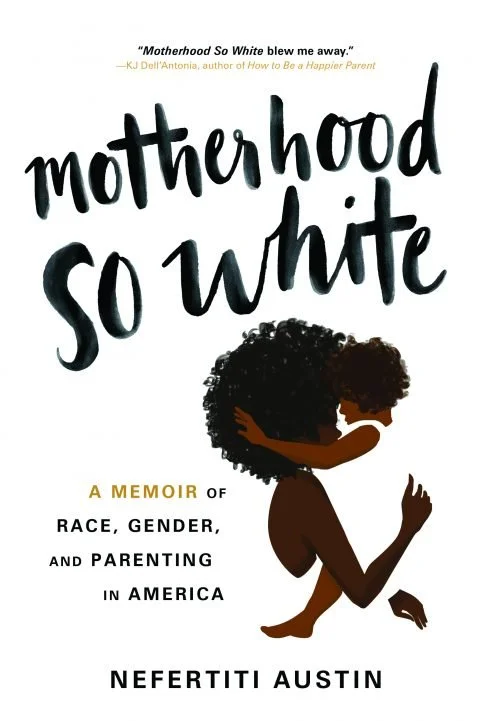
In honor of National Adoption Month, which is celebrated every November in the United States, I read the book Motherhood So White: A Memoir of Race, Gender, and Parenting in America by Nefertiti Austin. In her memoir, Austin shares her experience adopting as a single Black woman. While the discussion on the foster and adoption systems reflected opinions and choices that I don’t agree with, Motherhood So White is a great exploration of the gaps in support and resources for Black mothers in the United States.
Austin expected parenting information to be race-neutral, but, after adopting her son, she found that she “needed specific advice on how to handle the social and emotional consequences of becoming a single mother” (Chapter 8: “Motherhood So White”). Throughout her parenting journey, she noticed gaps in available books, advice, and media. She noticed that most available resources and positive representations of motherhood were of and for white mothers, primarily in two-parent households. Austin noted that, in 2018, when she was writing her memoir, there were fewer than 24 books in print written by or for Black mothers (Chapter 8: “Motherhood So White”).
Books and other media should not only give diverse perspectives, but they should also celebrate more expansive parenting configurations: single Black mothers, Black women dealing with infertility, Black women starting
families via surrogacy, and more. Celebrating mothers of all races, socioeconomic statuses, and familial makeup in the multitude of ways they create their families and balance their careers and motherhood is just one step towards maternal health equity. At the same time, it’s important to ensure that we avoid mythologizing mothers– we must recognize and allow imperfection.
In her epilogue, Austin leaves us with the following quote:
“Women of any race shouldn't have to be superstars for our status as mothers to be respected, no matter what each woman's path to motherhood is. Choosing adoption is a constant reminder that there are myriad ways to become a mother— adoption, IVF, surrogacy, biological, or stepparent. All mothers, be they lesbian, heterosexual, Black, white, Asian, Latina, queer, transgender, nonbinary, or disabled, have struggles, and we need to support each other. We each have the same dream of building better families, and this is possible, as long as we recognize and respect each other” (“Epilogue”).
I finished reading this book as potential rollbacks to the federal Pregnant Worker’s Fairness Act (PWFA) were reported by The New York Times. While the roll-backs aren’t confirmed, the E.E.O.C. is likely to impose restrictions on what can be considered a pregnancy-related condition. The PWFA was created so that pregnancy and pregnancy-related conditions don’t force workers to choose between their health, their families, and their livelihood. It’s not clear exactly what might be cut, but detractors have mentioned accommodations related to fertility treatment and abortion. This news is an unfortunate reminder that, for many, there are still only a small number of parenting paradigms that are considered worthy of protection and care. Narratives like Austin’s are so important in recognizing ways that parents can build families, and demonstrating the critical importance of supporting diverse pathways to parenthood.
By: C. Nickel