
From Toxic Stress to Collective Rest: Rewriting the Black Maternal Story

Each April, Black Maternal Health Week calls us to confront a crisis and to protect what sustains us. This year’s theme, “Rooted in Justice & Joy,” asks us to hold both truth and possibility at once. In the DMV (D.C., Maryland, Virginia), that means facing stark disparities while uplifting the communities leading change.
The data is clear. Black women in the U.S. are more than three times as likely to die from pregnancy-related causes as white women.[1] In D.C., maternal and infant health outcomes continue to receive failing grades, with preterm birth rates for Black babies far exceeding those of other
groups.[2] In Maryland and Virginia, disparities persist across outcomes, from cesarean deliveries to severe maternal morbidity.[3]
But behind these numbers is something deeper: mental health is a leading driver of maternal mortality. National research published in JAMA Psychiatry shows that mental health conditions—including postpartum depression, anxiety, substance use, and suicide—account for nearly 1 in 4 maternal deaths.[4] Yet Black mothers are significantly less likely to receive care. Many go without screening, support, or treatment during pregnancy and postpartum, navigating stigma and systemic barriers alone.[5]
Social, political, and commercial determinants of health shape these outcomes. Rising housing costs, job instability, lack of paid leave, and gaps in Medicaid coverage create chronic stress that directly impacts maternal health. In the DMV, where the cost of living continues to climb, these pressures are not abstract. They are daily realities. Hospital closures in historically Black communities, underinvestment in culturally competent care, and limited access to Black providers further deepen risk.[3]
And then there’s the cultural weight: the expectation to be strong, to endure, to push through. That pressure is not harmless. It is a health risk.[5]
Still, across this region, organizations and community networks that center Black mothers are building something different—models of care that center dignity, culture, and connection. This is what it means to be rooted in justice. And creating space for rest, healing, and joy? That is how we stay rooted.
Because joy is not extra, it is protective.
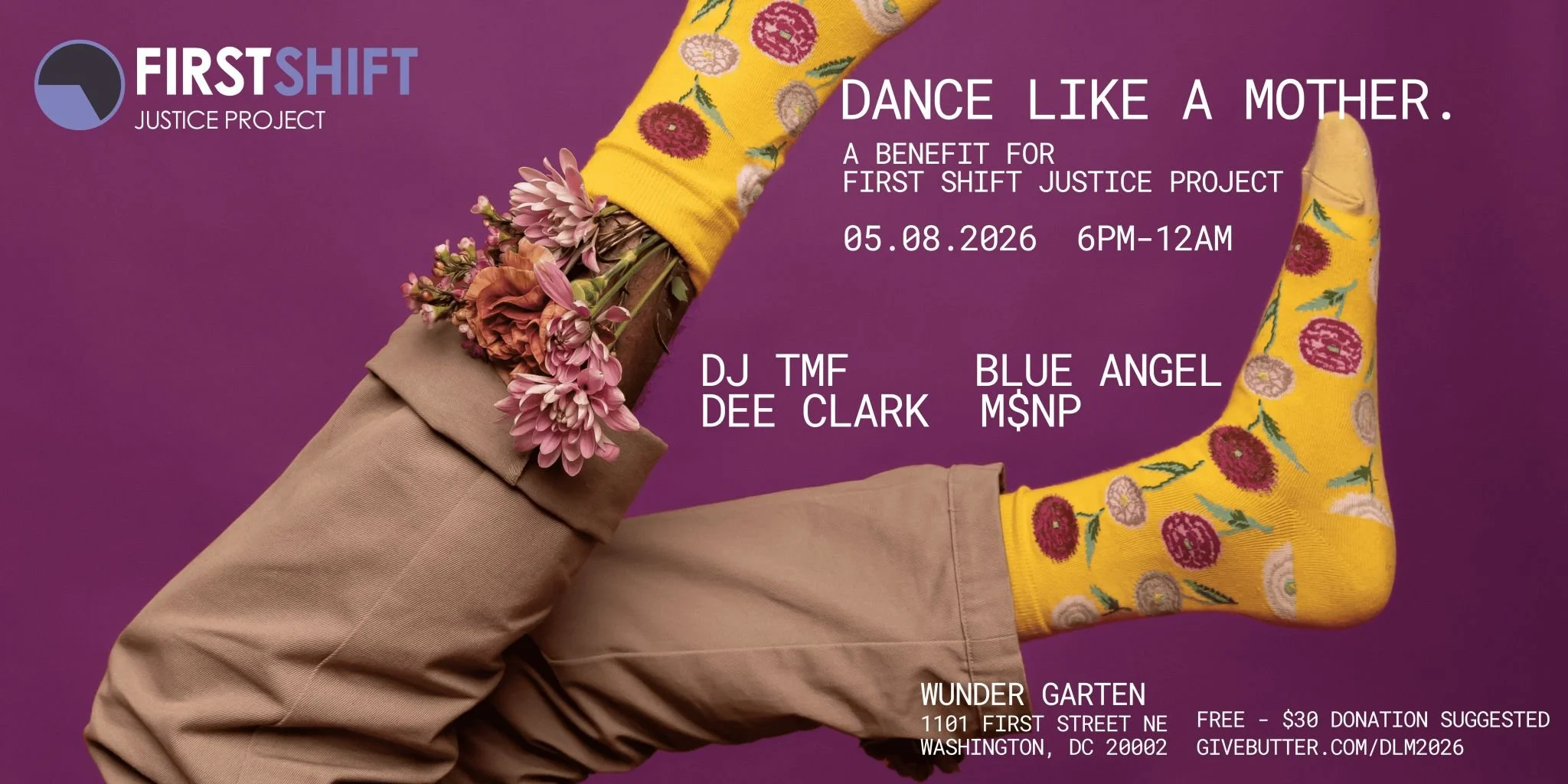
Join us in that spirit at “Dance Like a Mother” on May 8th, 2026, a fundraising event supporting First Shift Justice Project.
Come move, release stress, and connect with the community. In a time where mental health is both a risk and a pathway to healing, joy can be part of the solution.
By: Tamaron A. Johnson, MPH
Sources:
[1] Hoyert, D.L. (2025, February). Maternal Mortality Rates in the United States, 2023. National Center for Health Statistics, CDC. Cited in: NIHCM Foundation (2026, April). Maternal Health Outcomes & Children's Mental Health.nihcm.org
[2] March of Dimes. (2025, November). 2025 Report Card on Maternal and Infant Health: District of Columbia.prnewswire.com
[3] Office of Councilmember Laurie-Anne Sayles, Montgomery County. (April 9, 2025). Report Finding Maternal and Infant Mortality Metrics Trend Worse for Black Residents.montgomerycountymd.gov
[4] Children's National Hospital / JAMA Psychiatry. (2024, February). Maternal Mental Conditions Drive Climbing Death Rate in U.S.childrensnational.org
[5] Policy Center for Maternal Mental Health. (2024, October). Black Maternal Mental Health Issue Brief.policycentermmh.org